

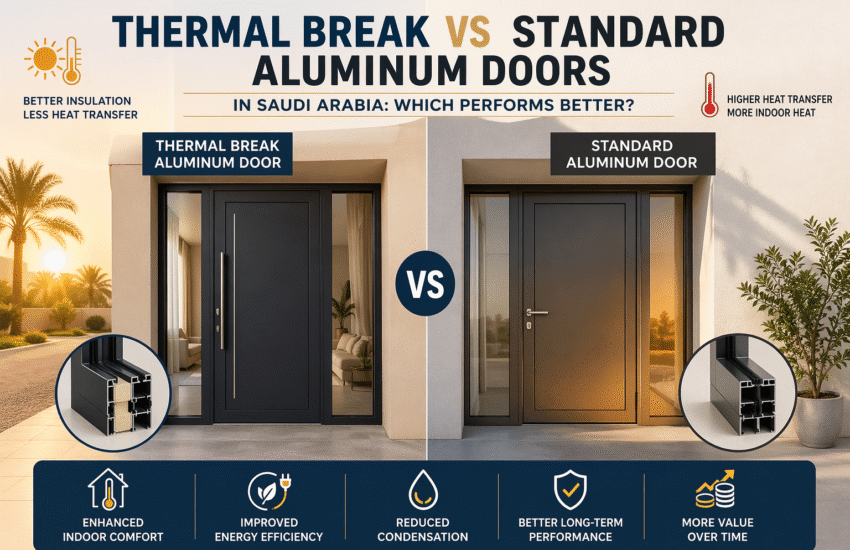
Homeowners in Saudi Arabia often compare aluminum doors with thermal break systems without fully understanding the difference. At first glance, both look similar. Both use aluminum frames. Both support modern designs with glass integration.
However, their performance under Saudi climate conditions is fundamentally different.
This difference becomes visible not in the showroom, but after installation especially during peak summer months when temperatures remain extreme for extended periods.
The Core Difference: Heat Transfer
Aluminum is a highly conductive material. When exposed to direct sunlight, it absorbs heat quickly and transfers it across the frame.
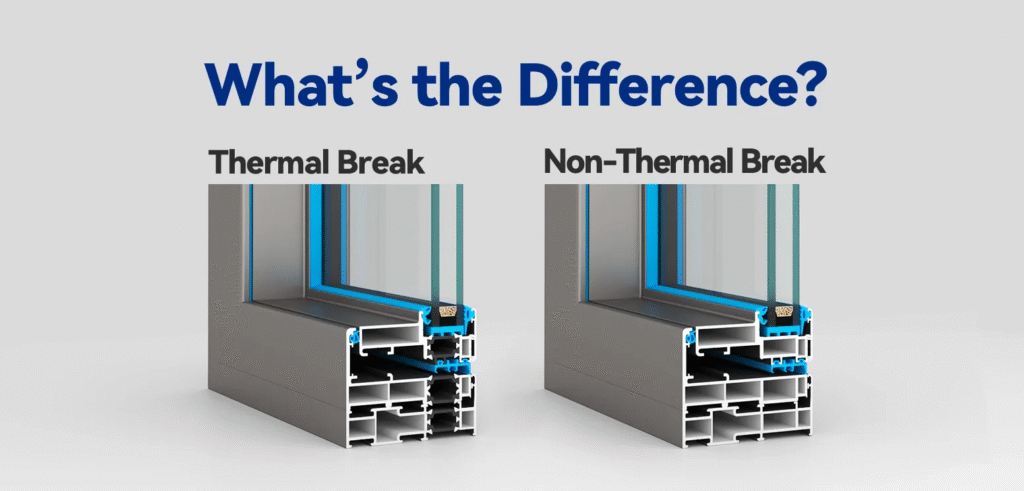
In a standard aluminum door, the exterior and interior sections of the frame are fully connected. This creates a continuous path for heat to move from outside to inside. As a result, the internal side of the door becomes warm, and the surrounding indoor area feels the impact.
A thermal break door interrupts this process. It includes a non-conductive barrier within the frame that separates the exterior aluminum from the interior section. This barrier significantly reduces heat transfer.
In real villa installations, this difference becomes noticeable by midday. Standard aluminum doors often feel hot from the inside, while thermal break doors remain closer to room temperature.
Impact on Indoor Comfort
Saudi homes rely heavily on air-conditioning for most of the year. Any external heat entering the building increases cooling demand.
Standard aluminum doors allow heat to pass through the frame, which creates localized warm zones near entrances. This is especially noticeable in villas with large entryways or doors exposed to direct sunlight.
Thermal break doors reduce this heat movement. They help maintain consistent indoor temperatures and prevent hot spots near the entrance area.
Over time, this contributes to a more comfortable living environment.
Energy Efficiency and Cooling Costs
Cooling costs form a significant portion of household expenses in Saudi Arabia. Even small improvements in insulation can lead to measurable savings.
Standard aluminum doors increase the load on air-conditioning systems because they allow continuous heat transfer. The cooling system must work harder to maintain the desired temperature.
Thermal break doors reduce this load by limiting heat entry. In larger villas, where entrance areas connect to open living spaces, the impact on energy efficiency becomes more pronounced.
Although the difference may not appear immediately in short-term use, it becomes clear over extended periods of high temperature.
Condensation and Moisture Behavior
Condensation is not always a major issue in Saudi Arabia, but it can occur in air-conditioned interiors, especially in coastal regions.
Standard aluminum frames can develop condensation when there is a significant temperature difference between interior and exterior surfaces. This happens because the metal conducts temperature directly.
Thermal break systems reduce this effect by isolating the internal frame from external temperature conditions. This improves surface stability and reduces the likelihood of condensation forming on interior sections.
Structural Strength and Design
Both standard aluminum and thermal break doors use similar base materials, but their internal construction differs.
Thermal break systems often use more advanced profile designs that accommodate insulation barriers. These profiles maintain structural integrity while improving performance.
From a design perspective, both systems support modern architecture. Slim frames, large glass panels, and clean lines are achievable with either option.
However, thermal break systems tend to be used more frequently in high-end villa projects where performance is as important as appearance.
Long-Term Performance in Saudi Conditions
Standard aluminum doors can perform adequately in mild environments, but Saudi Arabia’s climate exposes their limitations.
Continuous exposure to heat leads to expansion and contraction within the frame. Over time, this can affect sealing performance and alignment, especially if installation quality is not precise.
Thermal break doors handle temperature variation more effectively. The internal barrier reduces stress caused by heat transfer, which contributes to more stable long-term performance.
From project experience, thermal break systems maintain their sealing and operational consistency better over time.
Cost vs Value
Standard aluminum doors typically have a lower upfront cost. This makes them attractive for budget-conscious projects.
Thermal break doors require higher initial investment due to more complex manufacturing and materials. However, they provide better insulation, improved comfort, and reduced energy consumption.
For villa owners planning long-term occupancy, thermal break systems offer better overall value. The initial cost difference becomes less significant when viewed against energy savings and improved living conditions.
Which Option Is Right for Your Villa?
The choice depends on priorities.
Standard aluminum doors may suit projects where budget constraints are strict and thermal performance is not a primary concern.
Thermal break doors are better suited for villas where comfort, energy efficiency, and long-term performance matter. They are particularly valuable in properties with high sun exposure or large entrance openings.
In modern Saudi construction, thermal break systems are increasingly becoming the preferred choice rather than a premium upgrade.
Final Perspective
The difference between thermal break and standard aluminum doors is not cosmetic. It is functional and measurable.
In a climate like Saudi Arabia, where heat control defines indoor comfort, the performance of exterior doors plays a critical role. Thermal break doors address this challenge directly by reducing heat transfer and improving energy efficiency.
For homeowners who want their villa to perform as well as it looks, thermal break doors provide a solution aligned with modern building standards and environmental demands.

