

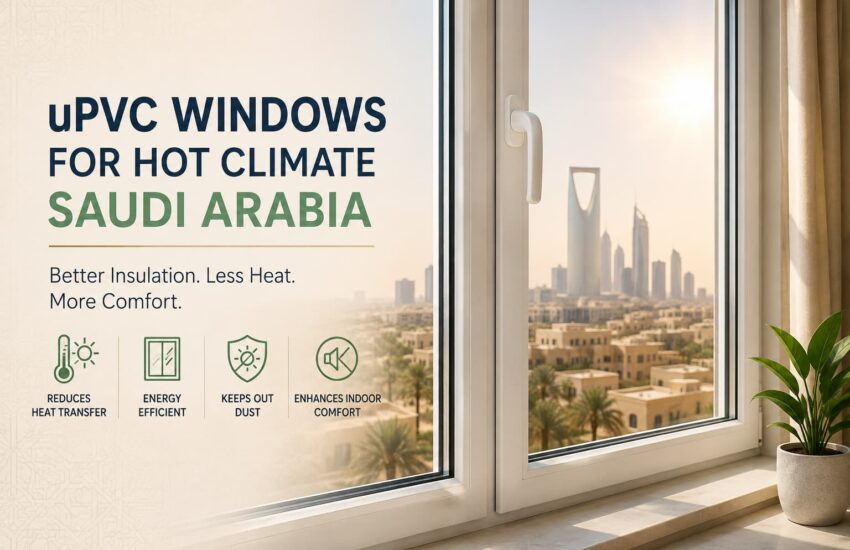
Saudi Arabia’s climate makes window selection an important part of residential and commercial building design. High summer temperatures, intense sunlight, airborne dust, and humidity in coastal areas can place significant pressure on conventional window systems.
For this reason, homeowners and property developers increasingly look for windows that provide reliable insulation while requiring minimal maintenance. uPVC windows are well suited to these requirements because their profile construction naturally limits heat transfer and provides effective protection against outdoor conditions when properly designed and installed.
However, the performance of a uPVC window depends on more than the frame material. The profile, glazing, seals, reinforcement, hardware, and installation must work together to deliver the expected results.
Understanding the Saudi Climate
The Kingdom has several distinct climatic regions, but most properties experience some combination of high temperatures, strong solar radiation, dust, and significant seasonal variation.
In Riyadh and much of central Saudi Arabia, extreme summer heat creates a major cooling requirement. In Jeddah, Dammam, Khobar, and other coastal areas, higher humidity and salt laden air introduce additional challenges.
Windows sit directly within the building envelope, so their performance has a noticeable effect on indoor conditions.
When a window transfers excessive heat or allows air to pass through poorly sealed joints, the air conditioning system has to work harder to maintain a comfortable indoor temperature.
This is why choosing an appropriate window system should be considered part of the building’s overall thermal strategy.
How UPVC Helps Reduce Heat Transfer
One of the main advantages of uPVC is its low thermal conductivity.
Unlike conventional metal profiles, uPVC does not readily conduct exterior heat into the interior. Modern uPVC profiles also use multiple internal chambers that create additional insulating barriers within the frame.
This construction helps reduce heat transfer between the outdoor and indoor environments.
For a villa with large glazed areas, this can be particularly important. The frame is only one part of the equation, but improving frame insulation helps create a more effective overall window system.
The result is a window that can contribute to better indoor comfort during Saudi summers.
The Importance of the Glass
A common mistake is to focus entirely on the uPVC frame.
In reality, the glass often occupies most of the window area, so its thermal properties have a major influence on the finished system.
For properties in Saudi Arabia, double glazing can provide considerably better insulation than traditional single glazing. The space between the two panes helps slow heat transfer, while specialized coatings can provide additional solar control.
Low emissivity glass can reduce heat transmission, while solar control glazing can help manage the amount of solar radiation entering the building.
The appropriate specification depends on factors such as the building’s location, façade orientation, window size, and desired level of thermal performance.
Why West Facing Windows Need More Attention
Not every window on a villa experiences the same conditions.
West facing façades can receive intense afternoon sunlight, particularly during the hotter months. Large windows in these locations can therefore contribute significantly to solar heat gain.
In practice, simply selecting a high performance frame is not always enough. The glazing specification, external shading, window size, and surrounding façade design should also be considered.
For a villa under design, identifying the most exposed façades early allows the architect and window supplier to select appropriate specifications rather than trying to solve heat problems after installation.
Let’s Talk — Get Your Quote Fast
Need pricing, drawings, or quick product guidance? Contact Maskni Alzaki and we’ll respond with a tailored quotation and technical support.
uPVC Windows and Dust
Dust is another important consideration for buildings across Saudi Arabia.
Windows that do not close tightly can allow dust and outdoor air to enter through gaps around the sash and frame. This can increase cleaning requirements and affect indoor comfort.
Quality uPVC systems use compression seals around opening sections to create a tighter closure. Properly manufactured frames also provide controlled drainage and carefully designed joints.
However, good sealing depends heavily on installation.
Even an excellent window can underperform if the frame is incorrectly positioned, the surrounding opening is poorly prepared, or the perimeter is inadequately sealed.
For this reason, installation should always be considered alongside the window specification.
How uPVC Performs in Coastal Saudi Arabia
The requirements change somewhat in coastal locations.
Cities such as Jeddah, Dammam, and Khobar experience higher humidity than many inland areas. Salt and moisture can also accelerate corrosion in susceptible metal components.
uPVC itself does not rust or corrode in the same way as untreated steel. This gives it an advantage where resistance to environmental exposure is important.
However, homeowners should not evaluate only the frame. Hinges, handles, reinforcement, fasteners, and other components also need to be appropriate for the environment.
A high quality uPVC system should therefore use compatible hardware and components designed for long term exterior exposure.
Thermal Insulation and Air Conditioning
Cooling is an essential part of everyday life in Saudi homes.
A window that allows significant heat into a room increases the cooling load. Over an entire villa with dozens of windows, these losses can become more noticeable.
uPVC windows can help reduce this thermal transfer through the combination of insulated profiles, suitable glazing, and effective sealing.
This does not mean replacing windows automatically guarantees lower electricity bills. Building orientation, insulation, roof construction, air leakage, glass specification, shading, and air conditioning efficiency all influence energy consumption.
What uPVC can do is improve one important part of the building envelope.
Acoustic Comfort Is Another Advantage
Thermal insulation is not the only performance consideration.
Modern uPVC windows can also provide effective acoustic insulation, particularly when paired with suitable double glazing and properly designed seals.
This can be valuable for villas and apartments located near busy roads, commercial areas, airports, or other sources of outdoor noise.
The final acoustic performance depends on the complete window and glass specification. Different glazing configurations provide different levels of sound reduction.
For properties in busy urban areas, acoustic requirements should therefore be discussed during window selection rather than after installation.
Low Maintenance Matters in Saudi Conditions
Exterior materials require regular cleaning in dusty environments.
uPVC has an advantage because its surface does not normally require painting or varnishing. Routine cleaning can generally maintain its appearance without the refinishing process associated with natural timber.
Moving components still require attention. Handles, locks, hinges, and seals should be checked periodically to ensure the window continues to operate correctly.
Keeping drainage channels clear is also important, particularly after periods of dust accumulation.
Good maintenance is simple, but it helps preserve the performance of the system over time.
Can uPVC Windows Handle Large Openings?
Modern villa designs increasingly feature large windows and expansive glazed façades.
uPVC can be used for substantial openings, but the design must account for the dimensions and weight of the glazing. Reinforcement, profile selection, hardware, and opening configuration become increasingly important as window size increases.
For particularly large architectural openings, aluminum systems may provide advantages because of their structural characteristics and ability to accommodate slim profiles.
This is why experienced suppliers do not recommend the same window configuration for every opening. The system should be selected according to the dimensions, function, exposure, and architectural requirements of each location.
uPVC Windows for New Villa Construction
For a new villa, window decisions should be made before the façade openings are finalized.
This allows the architect, contractor, and window supplier to coordinate the required dimensions, frame depths, sill details, drainage, insulation, and finishing.
It also provides an opportunity to evaluate the orientation of each façade.
A properly planned window system performs better than one selected at the final stage simply because it fits an existing opening.
This is particularly important for modern Saudi villas where large windows form a significant part of the architectural design.
What Makes a Good uPVC Window for Saudi Arabia?
The strongest performance comes from a complete, properly engineered system.
A homeowner should consider the quality of the uPVC profile, internal reinforcement, number and design of chambers, glazing specification, seals, hardware, drainage, and installation.
The profile should remain structurally stable under the expected conditions. The glazing should match the property’s thermal and solar requirements. Seals should provide reliable closure, while hardware should withstand repeated daily use.
Finally, the installation must maintain the intended performance of the system.
Looking at these elements together gives a much more accurate picture than comparing profile appearance or price alone.
Is uPVC Better for Saudi Arabia Than Traditional Aluminum?
Traditional aluminum remains a popular choice throughout Saudi Arabia, particularly because of its strength and slim appearance.
However, standard aluminum is a good conductor of heat. Without thermal break technology, it can transfer more exterior heat through the frame than a properly designed uPVC system.
Modern thermal break aluminum has improved considerably and can achieve excellent thermal performance. It can also provide advantages for very large openings and minimalist architectural designs.
For homeowners prioritizing thermal insulation, low maintenance, and practical performance, uPVC is a strong option. For projects where slim profiles and large glass areas are critical, thermally broken aluminum may be more suitable.
The correct decision should therefore be based on the requirements of the property rather than simply choosing one material universally.
Choosing uPVC Windows for Different Saudi Cities
The basic principles remain the same across the Kingdom, but local conditions should influence the final specification.
In Riyadh, solar exposure and extreme summer temperatures make thermal insulation and solar control glazing important considerations.
In Jeddah, humidity and coastal exposure make corrosion resistant components and appropriate hardware particularly important.
In Dammam and Khobar, the combination of heat, humidity, and coastal conditions makes both thermal performance and environmental resistance relevant.
In northern and higher elevation areas, seasonal temperature differences may also influence glazing and insulation requirements.
A professional supplier should evaluate these conditions before recommending a final system.
Final Thoughts
uPVC windows are well suited to many Saudi residential and commercial applications because they combine thermal insulation, weather resistance, low maintenance, and acoustic performance in a practical window system.
Their greatest advantage appears when the complete system is correctly specified. A high quality uPVC profile paired with suitable glazing, reliable seals, appropriate hardware, and professional installation can provide significantly better performance than a poorly specified window.
For Saudi villas, the objective should not simply be to find a window that looks attractive. The better approach is to select a system that can withstand the local climate while helping maintain a comfortable interior environment for years to come.
Frequently Asked Questions
Are uPVC windows good for hot weather in Saudi Arabia?
Yes. uPVC has low thermal conductivity and can help reduce heat transfer through the window frame. Performance improves further when the system uses suitable glazing and effective seals.
Can uPVC windows withstand Saudi sunlight?
Quality uPVC systems are designed for exterior use and can withstand prolonged environmental exposure. The profile formulation, surface quality, glazing, and overall manufacturing standard are important factors.
Are uPVC windows suitable for Riyadh?
Yes. Their thermal insulation makes them particularly suitable for Riyadh’s hot climate. Solar control glazing and appropriate shading can further improve performance.
Can uPVC windows be used in Jeddah?
Yes. uPVC provides good resistance to moisture and does not rust like untreated steel. Hardware and other components should still be selected for coastal conditions.
Do uPVC windows reduce electricity consumption?
They can contribute to lower cooling demand by reducing heat transfer, but actual energy savings depend on the entire building envelope, glazing, shading, air conditioning system, and other factors.
Should I choose double glazing for a Saudi villa?
Double glazing is worth considering for villas where thermal and acoustic performance are priorities. The ideal glass specification depends on the building’s location, orientation, window size, and design requirements.

