

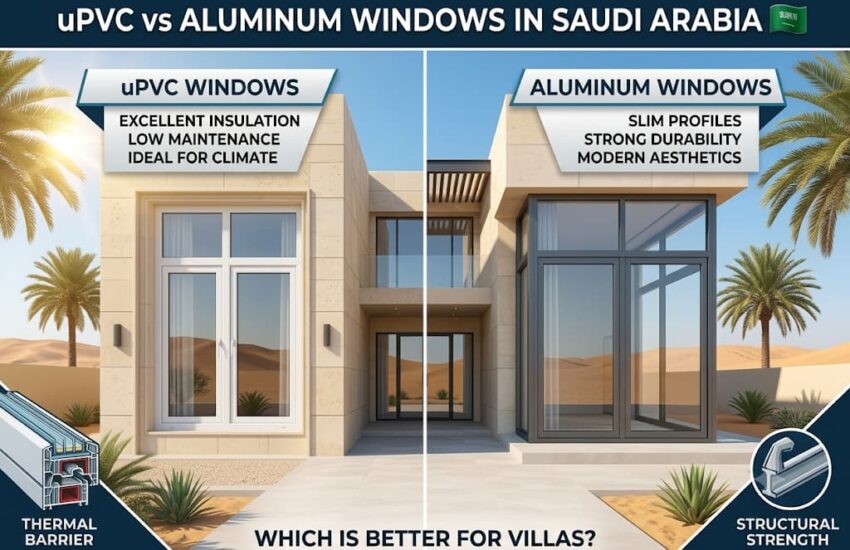
Choosing between uPVC and aluminum windows is an important decision for homeowners building or renovating a villa in Saudi Arabia. Both materials are widely used, but they perform differently depending on the window design, glazing, thermal requirements, and local climate.
For a Saudi villa, the right choice should account for more than appearance. Heat transfer, solar exposure, durability, maintenance, ventilation, acoustic comfort, and the size of the window openings all influence the final result.
uPVC has become increasingly attractive because of its thermal insulation and low maintenance, while aluminum remains popular for its strength, slim profiles, and modern architectural appearance. The better option depends on what the property requires.
uPVC and Aluminum Are Not the Same Window System
The material of the frame is only one part of a complete window. A finished window includes the frame, reinforcement, glazing, seals, hardware, drainage, and installation. Two windows made from different materials can therefore perform similarly if they use appropriately engineered systems.
Likewise, two windows made from the same material can perform very differently if one uses inferior profiles, glazing, hardware, or installation. For Saudi villas, it is more useful to compare complete window systems rather than simply asking whether uPVC or aluminum is better.
Thermal Insulation in the Saudi Climate
Thermal performance is one of the biggest differences between standard uPVC and conventional aluminum.
uPVC has relatively low thermal conductivity, which means it does not transfer heat as readily through the frame. Multi chamber uPVC profiles create additional insulating barriers that help reduce heat movement between the exterior and interior.
Aluminum, on the other hand, naturally conducts heat. A standard aluminum frame can therefore transfer significant exterior heat into the building.
Modern aluminum systems address this issue through thermal break technology. A thermal break separates the internal and external portions of the aluminum profile with an insulating material, substantially improving its thermal performance.
This means a high quality thermal break aluminum window can perform very well in Saudi conditions. The important distinction is between standard aluminum and thermally broken aluminum. Comparing basic aluminum directly with high performance uPVC does not provide a fair assessment.
Which Is Better for Reducing Heat?
For homeowners primarily concerned with thermal insulation, uPVC has a natural advantage over conventional aluminum. However, a premium thermal break aluminum system can provide excellent insulation as well.
The glass also has a major influence. A well insulated uPVC frame paired with poor single glazing may perform worse overall than a thermally broken aluminum system with high performance double glazing. For a villa in Saudi Arabia, the best approach is to evaluate the complete thermal package, including:
Frame + glazing + seals + shading + installation
This gives a more realistic indication of expected performance.
uPVC offers unbeatable insulation against the intense summer heat, while Aluminum provides a sleek, modern look perfect for large glass facades.
uPVC Windows for Riyadh Villas
Riyadh’s hot and dry climate makes thermal insulation a major consideration. Large windows exposed to direct sunlight can increase heat gain, particularly on south and west facing façades. In these areas, the combination of an insulated frame and appropriate solar control glazing becomes particularly important.
uPVC works well for many residential applications because the frame itself provides good thermal insulation without requiring a thermal break. For large contemporary openings, however, the architect may prefer aluminum because its structural characteristics allow slimmer profiles and larger glazed areas. The decision should therefore consider both the climate and the architectural design.
Aluminum Windows for Modern Villas
Aluminum remains a strong choice for contemporary villa architecture. Its structural strength allows manufacturers to create relatively slim frames, making it possible to increase the visible glass area. This is particularly useful for modern villas with large windows, expansive façades, and minimalist architectural lines.
Aluminum also supports a wide range of powder coated finishes and can be fabricated into many configurations. For homeowners who want extremely slim sightlines or very large glazed openings, a high quality aluminum system can provide advantages that uPVC may not match in every application.
Which Material Offers Better Security?
Security depends primarily on the complete window configuration rather than frame material alone. Both uPVC and aluminum windows can incorporate secure locking systems and reinforced components.
uPVC profiles can contain galvanized steel reinforcement to improve structural stability, while aluminum naturally provides a rigid frame structure. For ground floor villa windows, security should be evaluated alongside the glass specification. Laminated security glass, appropriate locking systems, and properly anchored frames can significantly improve resistance to forced entry. A strong frame with inadequate hardware is not a complete security solution.
Durability in Saudi Conditions
Both materials can provide long service when properly manufactured and installed. uPVC does not rust and generally requires little maintenance. High quality profiles are designed for exterior exposure and can withstand normal temperature and weather conditions.
Aluminum also provides excellent durability and corrosion resistance when properly finished. This makes it particularly useful in coastal Saudi cities where humidity and salt exposure can become important considerations.
The quality of the surface finish matters. Powder coating and other protective treatments help maintain the appearance of aluminum over time. In both cases, product quality matters more than choosing a material based solely on its name.
Let’s Talk — Get Your Quote Fast
Need pricing, drawings, or quick product guidance? Contact Maskni Alzaki and we’ll respond with a tailored quotation and technical support.
What About Coastal Cities?
For properties in Jeddah, Dammam, Khobar, and other coastal locations, environmental exposure should be considered carefully. uPVC offers an advantage because the frame itself does not rust. This makes it an attractive option where corrosion resistance is important.
Aluminum also performs well in coastal environments when the appropriate alloy, surface treatment, hardware, and installation materials are selected. The focus should therefore be on the complete specification.
A window supplier serving coastal Saudi Arabia should be able to recommend hardware and finishes suitable for the expected exposure rather than using exactly the same specification for every location.
Maintenance Comparison
Maintenance is another area where homeowners often notice a difference. uPVC generally requires simple cleaning and periodic inspection of seals and hardware. It does not require regular painting or varnishing.
Aluminum also requires relatively little maintenance, particularly when finished with a durable powder coating. Cleaning helps preserve the appearance, while hardware and drainage components should be checked periodically.
Neither material should require extensive routine maintenance when a quality system has been properly installed.
Acoustic Performance
Noise control can become important for villas near major roads, commercial areas, or densely populated neighborhoods. Both uPVC and aluminum windows can provide effective acoustic insulation when paired with appropriate glazing and sealing.
In practice, the glass often has a greater influence on acoustic performance than the frame material alone. Double glazing, laminated glass, and carefully selected glass thicknesses can improve sound reduction.
If acoustic comfort is important, homeowners should tell the supplier before finalizing the specification so that the glazing can be selected accordingly.
Which Is Better for Large Windows?
This is one area where aluminum often has an advantage. Large architectural openings place greater structural demands on the frame and hardware. Aluminum’s strength to weight characteristics allow manufacturers to create larger systems with relatively slim profiles.
uPVC can also be used for large windows, but profile selection, reinforcement, sash dimensions, and glazing weight need careful consideration.
For a villa featuring floor to ceiling windows or very large sliding openings, a high performance aluminum system may therefore be more appropriate. For standard villa windows where thermal insulation and low maintenance are priorities, uPVC remains an excellent option.
Appearance and Design Flexibility
Modern uPVC windows have moved well beyond the basic white frames associated with older systems. Today, homeowners can select different colours, wood effect finishes, opening configurations, and glazing options.
Aluminum offers even greater flexibility for minimalist architecture, particularly where narrow frames and large glass areas are required. The choice should reflect the architectural character of the property. A traditional or transitional villa may work well with wood effect uPVC, while a highly contemporary villa with large glass façades may benefit from slim aluminum profiles.
Cost and Long Term Value
The initial price should not be the only factor when comparing the two materials. A window’s long term value depends on its thermal performance, durability, maintenance, hardware, glazing, and expected service life.
uPVC can provide strong value where homeowners want good thermal insulation without the additional complexity of a thermal break system. Premium aluminum systems can cost more, particularly when they incorporate thermal breaks, high performance glazing, slim profiles, or large custom openings. However, the additional investment may be justified when the architectural design requires those characteristics.
uPVC vs Aluminum: Quick Comparison
| Feature | uPVC | Aluminum |
| Thermal insulation | Excellent | Excellent with thermal break |
| Standard heat conductivity | Low | High |
| Maintenance | Low | Low |
| Corrosion resistance | Excellent | Excellent with suitable finish |
| Slim profiles | Excellent | Excellen |
| Large openings | Good with proper reinforcement | Excellent |
| Design flexibility | High | Very high |
| Security | High with reinforcement and quality hardware | High |
| Acoustic performance | Excellent with suitable glazing | Excellent with suitable glazing |
| Saudi climate suitability | Excellent | Excellent when correctly specified |
So, Which Is Better for Saudi Villas?
For many homeowners, uPVC is the better choice when thermal insulation, low maintenance, and overall residential value are the main priorities. Aluminum becomes particularly attractive when the villa requires slim profiles, large glazed openings, highly contemporary architecture, or specific structural characteristics.
A thermally broken aluminum system can also deliver excellent energy performance, so homeowners should not automatically reject aluminum because of its thermal conductivity.
The best choice depends on the project’s requirements. For a standard villa with conventional window sizes, uPVC can provide an excellent balance of insulation, durability, and value. For a luxury villa with expansive glass façades and minimalist frames, premium aluminum may be the more suitable solution.
Final Thoughts
The debate between uPVC and aluminum should not be reduced to which material is universally better. Saudi Arabia has demanding environmental conditions, and both materials can perform successfully when the complete window system is properly engineered.
uPVC provides excellent thermal insulation, low maintenance, and strong suitability for residential applications. Aluminum offers exceptional structural strength, slim profiles, and architectural flexibility, particularly when thermal break technology is incorporated.
For homeowners planning a Saudi villa, the best decision comes from evaluating the property’s location, façade orientation, window dimensions, glazing requirements, architectural style, and long term performance expectations. The material should support the building rather than dictate the design.

