

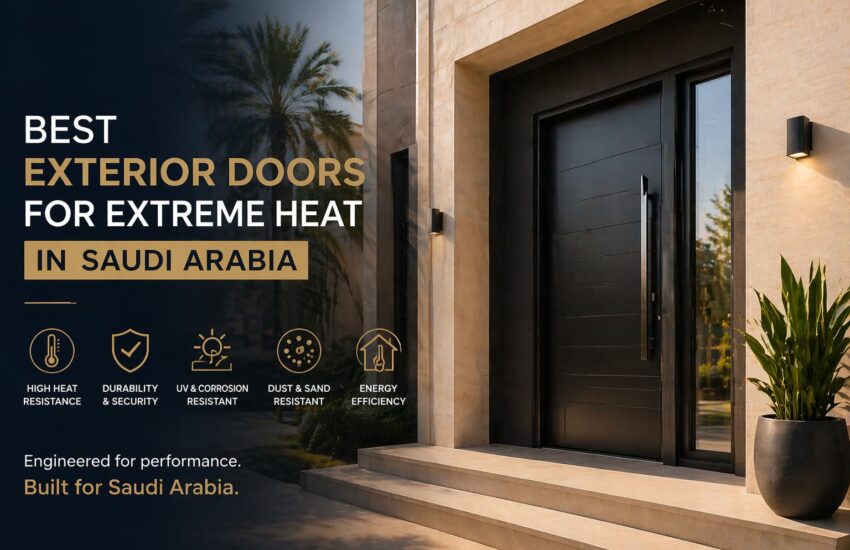
Choosing an exterior door in Saudi Arabia is not only a design decision. It is a performance decision that directly affects indoor comfort, energy consumption, and long-term durability.
In regions where temperatures remain high for most of the year, exterior doors face continuous thermal stress. Direct sunlight, hot air exposure, and dust accumulation all impact how a door performs over time. Many doors that appear strong at installation begin to show signs of failure within a few years because they are not designed for this environment.
Understanding which door systems perform best under extreme heat helps homeowners make informed decisions that last.
Why Extreme Heat Changes Door Performance
In moderate climates, most door materials perform adequately. In Saudi Arabia, conditions are different.
Exterior surfaces absorb heat throughout the day, especially on west- and south-facing façades. This heat builds up within the material and transfers inward. When the door lacks proper insulation, the interior side becomes warm, and the surrounding space loses cooling efficiency.
From project experience in Riyadh and Dammam, the most common complaints after installation include excessive heat near entrances, fading finishes, and reduced sealing performance. These issues are not random. They result from selecting door systems that are not engineered for high-temperature environments.
The best exterior doors for Saudi Arabia are those that manage heat transfer, maintain structural stability, and resist environmental wear.
Steel Doors in High-Temperature Environments
Steel doors remain one of the most reliable options for villa entrances when security and durability are priorities. Their structural strength allows them to withstand daily use and environmental stress without deformation.
However, not all steel doors perform equally under heat. Without proper internal insulation, steel conducts heat and transfers it indoors. This creates a temperature imbalance near the entrance.
High-performance steel doors solve this problem by incorporating insulated cores, such as polyurethane. This reduces heat transfer and improves indoor comfort. In addition, galvanized steel and UV-resistant powder coating protect the surface from corrosion and fading.
In residential projects, properly insulated steel doors maintain structural integrity and visual appearance for many years, even under direct sunlight.
Aluminum Doors and the Importance of Thermal Break
Aluminum doors are widely used in modern Saudi villas because they support clean architectural lines and large glass panels. However, standard aluminum conducts heat quickly.
In extreme heat, this becomes a major limitation. The door frame absorbs solar energy and transfers it indoors, increasing cooling demand.
Thermal break aluminum doors address this issue. By separating the exterior and interior aluminum sections with an insulating barrier, they reduce heat transfer significantly. This improves comfort and stabilizes indoor temperature.
From field experience, villas with thermal break doors show better temperature control near entrance areas compared to those using standard aluminum systems.
For modern designs, thermal break aluminum doors provide a balance between aesthetics and performance.
The Role of Glass in Heat Control
Glass selection plays a critical role in exterior door performance, especially when the design includes large glazed sections.
In Saudi Arabia, clear single glass allows significant heat penetration. This increases interior temperature and reduces energy efficiency.
High-performance doors use double glazing or low-emissivity glass to reduce heat gain. Tinted or reflective glass further limits solar radiation, particularly on façades exposed to strong sunlight.
In practice, the combination of insulated frames and performance glass determines the overall effectiveness of the door system. Ignoring glass specifications often leads to poor results, even when the frame quality is high.
Surface Finishing and Long-Term Durability
Extreme heat does not only affect structure. It also impacts surface finishes.
Low-quality coatings fade, discolor, or peel after prolonged sun exposure. Dark colors are especially vulnerable if they are not treated with UV-resistant technology.
High-grade powder coating and anodized finishes maintain color stability and resist environmental damage. In villa projects, choosing the right finish ensures that the entrance door retains its appearance over time.
Surface durability is often overlooked during selection, but it becomes one of the most visible signs of quality after installation.
Sealing and Dust Resistance
Heat in Saudi Arabia is often accompanied by dust and sand. Exterior doors must provide strong sealing to prevent infiltration.
Poor sealing allows hot air and dust to enter, which affects indoor air quality and increases cleaning and maintenance requirements.
High-performance doors include precision sealing systems that maintain tight closure even under temperature fluctuations. Proper installation also plays a key role in ensuring that seals remain effective.
From experience, doors with weak sealing systems require frequent adjustment and still fail to prevent dust entry during sandstorms.
Matching the Door to the Villa Design
Selecting the best exterior door is not only about choosing a material. It requires matching performance with architectural design.
Steel doors suit villas where security and durability are the primary concerns. Thermal break aluminum doors fit modern designs that emphasize glass, openness, and minimalism.
In many projects, homeowners combine both. Steel is used for main secure entrances, while aluminum systems are used for secondary access points or visually prominent façades.
The correct approach depends on exposure to sunlight, design goals, and performance expectations.
Let’s Talk — Get Your Quote Fast
Need pricing, drawings, or quick product guidance? Contact Maskni Alzaki and we’ll respond with a tailored quotation and technical support.
Installation and Real-World Performance
Even the best door system will not perform properly if installation is poor.
Incorrect alignment creates gaps that allow heat and dust to enter. Weak anchoring leads to movement over time. Incomplete sealing reduces insulation performance.
Professional installation ensures that the door operates smoothly, seals correctly, and maintains long-term stability. In Saudi conditions, installation quality often determines whether a door performs as expected or fails prematurely.
Final Perspective
Extreme heat changes how materials behave. It exposes weaknesses that remain hidden in milder climates.
The best exterior doors for Saudi Arabia are not defined by appearance alone. They are defined by their ability to control heat, resist environmental stress, and maintain performance over time.
Steel doors with proper insulation and thermal break aluminum doors represent the most reliable solutions for villa entrances. When combined with the right glass, finishing, and installation, they provide long-term comfort and durability.
Choosing the right system from the beginning prevents costly adjustments later and ensures that the door continues to perform under the realities of Saudi living.

